
Disclosure: This site may contain affiliate links. If you purchase through these links, we may earn a commission at no additional cost to you.
What Is a Book Feature Article and Why Does It Help Authors Get Discovered?
Feature articles give your book something no ad or social media post can: a full story, told to an audience that’s already reading. Here’s what book feature articles are, how they work, and why they’re one of the most effective and underused tools for author discovery.
Every author faces the same fundamental challenge: getting their book in front of readers who don’t know it exists yet.
Advertising can do this, but it’s expensive and increasingly competitive. Social media can do this, but the algorithm decides who sees your posts. Book reviews help, but they require readers to already be on your book’s page.
There’s another path that most authors overlook entirely: the book feature article.
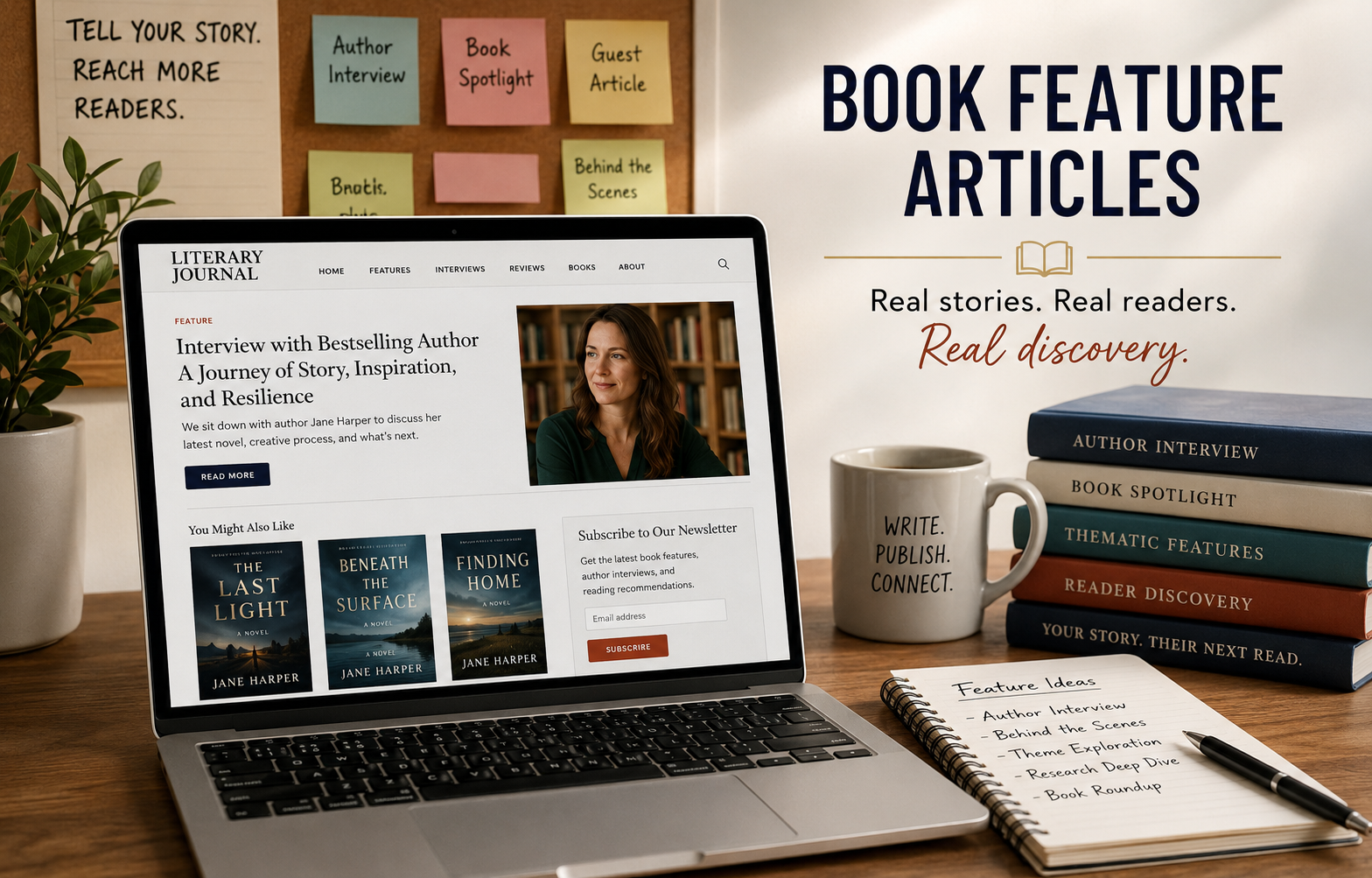
A feature article is a dedicated written piece published on a website, blog, newsletter, or online magazine that highlights your book, your story as an author, or the themes your work explores. It’s not a review. It’s not an ad. It’s editorial content that introduces your book to an audience in a format they’re already engaged with: reading.
Unlike a social media post that disappears in hours, a feature article lives permanently on the web, generating discovery for months or years after publication.
What a Book Feature Article Actually Is
A book feature article isn’t a standard book review, though it may include elements of one. It’s a more substantial piece of content that tells a story about the book, the author, the creative process, or the themes the book explores.
Feature articles come in several forms.
Author Profiles and Interviews
These articles focus on you as the author. They cover your background, what inspired the book, your writing process, and what readers can expect.
They give readers a personal connection to the person behind the work, which can significantly increase the likelihood of a purchase.
Book Spotlight Articles
These are dedicated pieces that highlight your book specifically, covering the premise, themes, genre positioning, and what makes it stand out.
A well-written book spotlight reads like a recommendation from a trusted friend rather than a sales pitch.
Thematic Feature Pieces
These articles explore a theme or topic related to your book, weaving in references to your work naturally.
If your novel deals with grief, a feature article about “How Fiction Helps Us Process Loss” that mentions your book alongside others positions you within a larger conversation readers care about.
Roundup and List Features
Articles like “10 Must-Read Thrillers This Summer” or “Books Every Entrepreneur Should Read in 2026” place your book alongside other titles, reaching readers who are actively looking for recommendations in your genre.
Behind-the-Scenes and Research Pieces
If your book involved significant research into historical events, scientific topics, specific locations, or specialized subject matter, a feature article about that research process can attract readers who are interested in the subject itself.
That creates a natural bridge to your book.
Why Feature Articles Work Better Than You’d Expect
The effectiveness of feature articles comes down to three factors that most other marketing channels can’t replicate: context, permanence, and trust.
Context: Meeting Readers Where They’re Already Reading
When a reader encounters your book through a feature article, they’re already in reading mode. They’re on a blog, website, or newsletter they’ve chosen to engage with. Their attention is focused. Their mindset is receptive.
Compare this to social media, where your book promotion competes with vacation photos, political arguments, and cat videos in a feed designed to be scrolled past.
Or compare it to Amazon, where your book sits alongside millions of others with no editorial context to differentiate it.
A feature article provides something no other channel does: a full narrative context for your book. The reader understands not just what the book is, but why it matters, who wrote it, and what they’ll experience if they read it.
That context can convert browsers into buyers at a much higher rate than a cover image and a two-line description.
Permanence: Content That Keeps Working
A tweet or Instagram post has an effective lifespan of hours. A feature article published on a website with decent search authority can generate traffic for years.
Every feature article is indexed by Google. When someone searches for topics related to your book, your genre, your themes, or your name, those articles can appear in search results.
Each one becomes an evergreen entry point that brings new readers to your work without any additional effort from you after publication.
Over time, multiple feature articles create a cumulative web of discoverable content. Your online footprint grows. Your name becomes more searchable. Your book becomes easier to find.
This is the compound effect of permanent content and it’s something no amount of social media posting can replicate.
Trust: Borrowed Credibility
When your book is featured on an established website, blog, or newsletter, you inherit some of that platform’s credibility.
A reader who trusts a particular book blog is more likely to trust its recommendation of your book than your own self-promotion.
This borrowed credibility is especially valuable for newer authors who haven’t yet built a large readership. A feature on a respected platform signals to readers that your work has been noticed and considered worthy of attention.
It’s the digital equivalent of a bookstore staff recommendation: personal, curated, and trusted.
Paid vs. Earned Feature Articles
Feature articles generally fall into two categories: earned and paid.
Earned placements are articles that websites, blogs, or newsletters publish because they genuinely believe your book is worth featuring. You pitch the editor, they evaluate your book, and if it fits their audience, they write about it.
Earned placements carry maximum credibility because the editorial decision was independent.
Paid placements are articles you pay to have published on specific platforms. These are common in the indie author world and range from affordable blog features to premium placements on high-traffic book discovery sites.
Paid placements are clearly labeled as such on reputable platforms. While they carry slightly less implicit editorial endorsement, they still provide the benefits of context, permanence, and discoverability.
Both types have value. The best approach for most authors is a combination: pursue earned placements through outreach and relationship building while strategically investing in paid placements that put your book in front of well-targeted audiences.
Important distinction: paid feature articles on reputable book platforms are not the same as vanity press schemes or predatory “pay to publish” services. Legitimate paid placements are transparent about the arrangement, provide genuine visibility to real readers, and are a standard part of many book marketing budgets.
How to Get Feature Articles for Your Book
Whether you’re pursuing earned or paid placements, the process starts with preparation.
Build Your Media Kit
Before pitching anyone, assemble a clean, professional media kit that includes:
A high-resolution author photo
Your author bio in multiple lengths, such as 50 words, 150 words, and 300 words
Your book’s description, genre, and comparison titles
A high-resolution cover image
Links to existing reviews, awards, or notable mentions
Contact information and social media handles
Having these materials ready makes it easy for editors and bloggers to say yes. Every barrier you remove increases your chances of placement.
Identify the Right Platforms
Not every website is relevant to your book. Focus your efforts on platforms whose audience overlaps with your ideal reader.
Good options include:
Genre-specific book blogs and review sites
Author interview and book discovery platforms
Literary magazines and online publications
Newsletter curators in your genre
Niche websites related to your book’s themes or topics
Quality matters more than quantity. One feature on a platform with an engaged, targeted audience is worth more than ten features on sites with no relevant traffic.
Craft a Strong Pitch
When reaching out to editors or blog owners, keep your pitch concise and focused on value to their audience, not just your desire for promotion.
Explain why their specific readers would enjoy your book. Offer unique angles, such as an author Q&A, a behind-the-scenes piece on your research, or a themed article that connects your book to a timely topic.
Make it easy for them to say yes by being professional, responsive, and flexible about format.
Be Patient and Persistent
Not every pitch will land. That’s normal.
Keep a running list of target platforms, track your outreach, and follow up politely if you don’t hear back.
Building relationships with bloggers and editors pays dividends over time. Even if they can’t feature your current book, they may be a perfect fit for your next one.
The Long-Term Value of Feature Articles
Think of each feature article as a small, permanent billboard for your book, one that lives on the internet, generating impressions and clicks without ongoing cost or effort.
An author with ten feature articles across different platforms has ten entry points for reader discovery. Each one reaches a different audience. Each one appears in different search results.
Together, they create a network of visibility that no single marketing channel can match.
This is particularly powerful for backlist titles. Long after launch day, feature articles can continue driving discovery and sales.
A reader who stumbles across a two-year-old feature article about your book is just as likely to click through and buy as someone who read it on publication day.
For authors building a multi-book career, this cumulative effect is transformative. Every feature article for every book adds to your total discoverability.
By the time you release your fifth book, you might have 30 or 40 feature articles working for you across the web, a permanent, growing marketing engine that requires no daily maintenance.
The Bottom Line
Book feature articles are one of the most effective and underused tools in an author’s marketing toolkit.
They provide what social media can’t: deep context, lasting permanence, and borrowed credibility from trusted platforms.
Whether earned through outreach or strategically purchased on reputable book discovery sites, feature articles create permanent pathways between readers and your work.
They work while you sleep, while you write your next book, and while the social media algorithms change their minds about who gets to be seen today.
If you’ve been pouring all your marketing energy into social media and wondering why it’s not moving the needle, feature articles might be the missing piece.
Your book deserves to be discovered. Feature articles make that discovery possible, not just on launch day, but for years to come.

Comments (0)
No comments yet. Be the first!