
Disclosure: This site may contain affiliate links. If you purchase through these links, we may earn a commission at no additional cost to you.
What New Amputees Wish People Understood About Recovery
The first thing most people notice after an amputation is what is missing.
The first thing an amputee notices is that everything has changed.
Those two perspectives often create a gap that is difficult to explain. Family members, friends, coworkers, even well-meaning strangers usually focus on the physical loss. They wonder about the prosthetic leg, the wheelchair, the walker, the surgery, or the rehabilitation appointments. Those things are certainly part of recovery, but they are only the surface.
Recovery after limb loss reaches into every corner of life. It changes how a person wakes up in the morning, how they move through their home, how they think about themselves, how they interact with others, and how they imagine the future. It affects confidence, relationships, routines, careers, hobbies, and identity in ways that cannot always be seen.
Many new amputees quietly carry thoughts they never say aloud because they fear becoming a burden or because they believe no one else could understand.
That is why conversations matter.
That is why listening matters.
And that is why so many new amputees say they wish people understood what recovery is really like.
Recovery Is Not a Straight Line
One of the biggest misconceptions is that healing follows a predictable schedule.
People often imagine surgery, rehabilitation, a prosthetic fitting, and then life simply returns to normal.
Real life rarely works that way.
There are good days that feel full of possibility.
There are difficult days that seem to erase weeks of progress.
A new amputee may walk confidently with a prosthetic one afternoon and struggle to put weight on it the following morning because of swelling, soreness, poor socket fit, weather changes, or simple exhaustion.
Recovery isn't measured by a straight line moving upward.
It is measured by persistence.
Some weeks are filled with victories.
Others are filled with adjustments.
Learning to accept that reality is often one of the hardest lessons.
Friends and family sometimes unintentionally add pressure by asking questions like:
"Are you walking yet?"
"When will you be back to normal?"
"Didn't you already finish therapy?"
Those questions usually come from genuine concern.
But they can also remind an amputee that others expect recovery to happen faster than it actually does.
The truth is that healing continues long after the surgical wound closes.
A Prosthetic Is Not a Magic Solution
Movies and news stories often celebrate the first steps with a prosthetic leg.
Those moments are emotional.
They are inspiring.
They are also only the beginning.
Learning to use a prosthesis is like learning an entirely new way to move through the world.
The socket may fit differently every day.
Residual limb volume changes.
Pressure points appear.
Skin becomes irritated.
Muscles that have never worked together before suddenly must cooperate.
Balance must be relearned.
Walking across a smooth therapy floor is very different from walking across gravel, wet grass, loose sand, uneven sidewalks, ramps, curbs, or crowded stores.
Every surface presents a new lesson.
Many amputees spend months, or even years, fine-tuning sockets, liners, suspension systems, and alignment.
Some days the prosthetic feels like part of the body.
Other days it feels like carrying an awkward piece of equipment that simply refuses to cooperate.
People often say,
"You've got your leg now, so things must be easier."
Sometimes they are.
Sometimes they are much harder.
Pain Doesn't End With Surgery
Many people assume pain disappears after the limb is gone.
Anyone living with amputation knows better.
Phantom pain can feel startlingly real.
Burning.
Cramping.
Electric shocks.
Itching in toes that no longer exist.
Pressure in a foot that isn't there.
These sensations are difficult to describe because they sound impossible to someone who has never experienced them.
Residual limb pain also changes daily.
Sockets create pressure.
Muscles fatigue.
Scar tissue tightens.
Weather affects sensitivity.
Even emotional stress can influence physical discomfort.
Pain is not always visible.
Someone may smile throughout dinner while silently enduring discomfort that would make others stop what they were doing.
That invisible reality deserves understanding instead of skepticism.
Recovery Changes Identity
Losing a limb often feels like losing part of the life someone expected to live.
Activities that once seemed automatic suddenly require planning.
Simple errands become logistical exercises.
Questions appear that never existed before.
Can I get inside?
Will there be stairs?
Where is the accessible restroom?
Can I stand long enough?
Will people stare?
Can I keep up?
These questions accumulate.
They quietly reshape confidence.
Many amputees also grieve the version of themselves they once knew.
Not because they believe life is over.
But because change always brings loss.
Accepting a new identity takes time.
Some days an amputee feels incredibly capable.
Other days they simply miss who they used to be.
Both emotions can exist together.
Independence Takes Time
One of the greatest desires after limb loss is to regain independence.
Not because help isn't appreciated.
Because independence represents dignity.
The first shower alone.
Driving again.
Cooking dinner.
Walking through a grocery store.
Carrying laundry.
Taking out the trash.
Picking up grandchildren.
Returning to work.
These ordinary moments become extraordinary victories.
People often celebrate the major milestones while overlooking the hundreds of tiny accomplishments that happen quietly at home.
Every task relearned builds confidence.
Every successful day creates momentum.
Every setback teaches another lesson.
Recovery is often measured in moments that nobody else ever sees.
Emotional Recovery Is Just as Important
Physical therapy is essential.
Mental recovery is equally important.
Fear.
Anger.
Grief.
Embarrassment.
Frustration.
Hope.
Relief.
Pride.
All of these emotions may appear within the same day.
Many amputees feel guilty for struggling emotionally because they believe they should simply be grateful to be alive.
Gratitude and grief are not opposites.
They can coexist.
Someone can appreciate surviving while simultaneously mourning everything that changed.
Ignoring emotions rarely makes them disappear.
Acknowledging them often becomes the first step toward healing.
The Things Many Amputees Never Say
There are thoughts many amputees keep private.
"I don't want people staring."
"I'm tired of explaining my story."
"I wish someone would ask how I'm really doing."
"I'm afraid of falling."
"I'm worried about becoming a burden."
"I miss doing simple things without thinking."
"I'm exhausted."
"I'm trying harder than anyone realizes."
These thoughts often remain hidden because people don't want to worry family members.
Or they fear sounding negative.
Or they believe others expect them to stay positive all the time.
But honest recovery requires honest conversations.
Healing grows where honesty is welcomed.
Journaling Creates a Safe Place
Many people discover they can write things they struggle to say aloud.
That is one reason journaling has become such a valuable recovery tool.
A blank page doesn't interrupt.
It doesn't judge.
It doesn't compare.
It simply listens.
Writing allows emotions to slow down enough to be understood.
Instead of carrying every fear internally, an amputee can place those thoughts onto paper.
Sometimes the act of writing reveals patterns.
Certain situations create anxiety.
Certain accomplishments build confidence.
Certain people consistently encourage hope.
Other entries reveal growth that otherwise goes unnoticed.
A journal becomes more than a notebook.
It becomes evidence that healing is happening, even when progress feels invisible.
Prompts Help Find the Right Words
Many new amputees sit down to journal and immediately wonder,
"What do I write?"
That uncertainty is completely normal.
Guided prompts remove the pressure of starting from nothing.
Simple questions invite honest reflection.
What challenged me today?
What surprised me?
What made me smile?
What frustrated me?
What am I proud of?
What do I need tomorrow?
These questions often uncover emotions people didn't realize they were carrying.
Some prompts encourage gratitude.
Others encourage forgiveness.
Some simply encourage honesty.
There is no right answer.
Only a truthful one.
Over weeks and months, these reflections become a powerful record of personal growth.
Families Are Recovering Too
Limb loss affects more than one person.
Spouses adjust.
Children adapt.
Parents worry.
Friends wonder how to help.
Caregivers often carry their own fears while trying to remain strong.
They may feel helpless.
Overwhelmed.
Exhausted.
Unsure whether they are doing enough.
They are recovering too.
Their recovery simply looks different.
Families often benefit from talking openly about expectations, frustrations, victories, and fears.
Silence creates distance.
Conversation builds connection.
Caregivers Need Encouragement
Caregivers frequently place their own needs last.
They organize appointments.
Drive to therapy.
Help with dressing.
Manage medications.
Offer emotional support.
Celebrate victories.
Comfort during setbacks.
They deserve encouragement as well.
A healthy caregiver is better equipped to support recovery.
Sometimes the best question isn't,
"How is the amputee doing?"
Sometimes it is,
"How are you doing?"
Both answers matter.
Healing Together
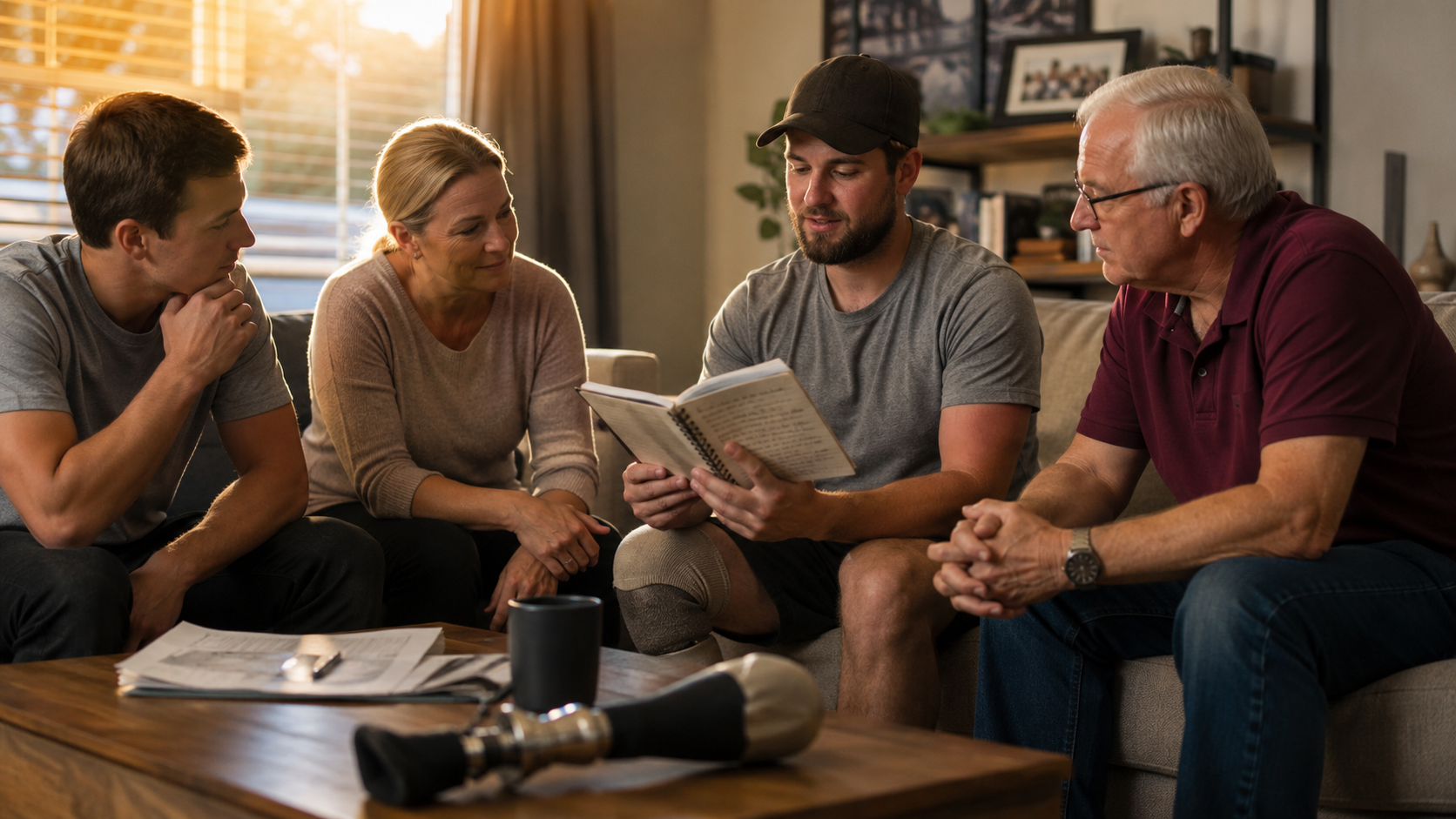
One of the unexpected strengths of keeping a recovery journal is that it can become a shared experience.
Some families read selected entries together.
Others answer prompts separately and compare perspectives.
Some write encouraging notes for one another.
These shared reflections often create conversations that otherwise never happen.
A spouse may discover fears their partner never voiced.
Children may express worries they kept hidden.
Parents may better understand how much progress has already occurred.
The journal becomes less about recording events.
It becomes a bridge between people learning this new life together.
Celebrate Small Victories
Recovery is built one small victory at a time.
Putting on a liner without help.
Standing a little longer.
Walking a few extra steps.
Sleeping through the night.
Going to church.
Visiting friends.
Driving again.
Returning to work.
Laughing without thinking about the amputation for a few minutes.
These moments deserve celebration.
They are proof that life continues moving forward.
What New Amputees Need Most
Most new amputees do not expect others to completely understand.
They simply hope people will listen.
Listen without rushing to solve every problem.
Listen without comparing their journey to someone else's.
Listen without assuming recovery has an expiration date.
Ask questions.
Be patient.
Celebrate progress.
Accept difficult days.
Remain present.
Compassion rarely requires perfect words.
It usually requires consistent presence.
The Real Story
Recovery after limb loss is far more than learning to walk again.
It is learning to live again.
It is discovering new confidence while grieving old routines.
It is accepting help while fighting for independence.
It is balancing hope with frustration.
It is choosing to keep moving forward despite setbacks that no one else can see.
Every amputee's journey is different.
Every story deserves to be heard.
That is one of the reasons a recovery journal can become such a meaningful companion during the first year after limb loss.
It provides a place to record victories that others might overlook.
It creates space for difficult emotions that deserve acknowledgment.
It helps identify growth that is often invisible in daily life.
Perhaps most importantly, it reminds both amputees and their loved ones that healing is not measured only by miles walked or appointments completed.
Healing is measured by courage shown one ordinary day at a time.
Understanding begins when people stop assuming they know the story and start listening to the person living it.

Comments (0)
No comments yet. Be the first!